Search This Blog

Tuesday, 8 March 2016

OpenTX eepe and bin model files

Here are all my current models with downloadable OpenTX version 2.16 eepe files.
I use the Taranis plus for powered planes and thermal gliders where telemetry is useful,
and the Turnigy 9XR Pro for slope soarers at salty, sandy coastal sites.
I use spoken flight duration minutes on all models (not a global function)

Taranis Plus models (eepe files)

Global functions (apply to all models)
Volume adjust - RS (Right slider)
Save logs to SD card - SE switch not up

Fokker Dr1 triplane
A crowd favourite but very draggy and struggles in any wind. A slow flying spectacle.
Stig's head turns with the rudder and also full L or R with a switch.
 

Fokker Dr1 eepe file

Motor - Hextronic DT750
Prop - 11 x 5.5"
ESC - 40A
Battery - 4S 3000mAH
Sensor - 40A current

Receiver - X8R
1 - R aileron
2 - L aileron
3 - throttle
4 - elevator
5 - rudder
6 - Stig

Expo Ail Ele Rud - 30
Differential - 50
Rudder Aileron mix - 50
Throttle override - SE up
Stig on rudder and SA
Spoken CNSP and VFAS - SD up
Spoken current - SD middle

DH82 Tigermoth biplane
A very smooth and satisfying flyer capable of mild aerobatics.  Steady and reliable, great camera and FPV platform.

Tigermoth eepe file

Motor - Hextronic DT750
Prop - 11 x 5.5"
ESC - 40A
Battery - 3S 3000mAH
Sensor - 40A current

Receiver - X6R
1 - R aileron
2 - L aileron
3 - throttle
4 - elevator
5 - rudder

Expo Ail Ele Rud - 30
Differential - 50
Snapflaps - 20 (only for inverted flight or Ele stick forward)
Rudder Aileron mix - variable via S1 knob
Throttle override - SE up
Spoken CNSP and VFAS - SD up
Spoken current - SD middle

DH53 Hummingbird
A wonderful smooth flyer. Faster and more agile than the Tigermoth but still looks very retro.

Hummingbird eepe file

Motor - Sunnysky X2212 980kV
Prop - 11 x 5.5"
ESC - 40A
Battery - 3S 2650mAH
Sensor - 40A current

Receiver - X6R
1 - R aileron
2 - L aileron
3 - throttle
4 - elevator
5 - rudder

Expo Ail Ele Rud - 30
Snapflaps - 40 only for forward Ele stick (inverted flight)
Rudder Aileron mix - variable via S1 knob
Throttle override - SE up
Spoken CNSP and VFAS - SD up
Spoken current and RSSI - SD middle

Bixler 2
Classic motor glider, great camera platform and longer range FPV plane. Also a very smooth sloper.
Flap servos removed, flaps and ailerons taped together for full span flaperons.

Bixler 2 eepe file

Motor - Turnigy 2826 2200kV
Prop - 6 x 4"
ESC - 40A
Battery - 3S 2200 - 3000mAH
Sensor - GPS and 40A current

Receiver - X8R
1 - R aileron
2 - L aileron
3 - throttle
4 - elevator
5 - rudder
8 - beeper

Expo Ail Ele Rud - 20
Spoilerons - SF (momentary) down
Rudder Aileron mix - 30
Throttle override - SE up
Lost model beeper - SH down
Spoken CNSP and VFAS - SD up
Spoken altitude - SD middle
Spoken distance and RSSI - SD down
Spoken RSSI every 4 sec if RSSI less than 50 - always ON

Bixler 2 with Bigaole RTH Flight Controller

Bixler 2 RTH eepe file

Normal flight - SG up
Stabilised flight - SG middle
Return to Home - SG down
Failsafe sets throttle at 40% and activates SG down (RTH)

Receiver - X8R
1 - R and L aileron
2 -
3 - throttle
4 - elevator
5 - rudder
8 - lost model alarm

Sipkill Wing
Mad little wing for close in, ripping around on FPV

Sipkill Wing eepe

Motor - Turnigy 2822 1450kV
Prop - 7 x 4"
ESC - 30A
Battery - 3S 2200mAH

Receiver - DIY 801
1 - R elevon
2 - L elevon
3 - throttle

INPUTS
Ail
Rate 50% and Expo 50% - SC up
Rate 75% and Expo 50% - SC middle
Rate 100% and Expo 90% - SC down
Ele
Rate 60% and Expo 40%

MIXES
Ch1 -90 Ail -100 Ele
Ch2 90 AIl -100 Ele

Throttle override - SE up

Acrobat
Mad acrobatic plane with oversized control surfaces

Acrobat eepe file

Motor - Turnigy 2836 1000kV 
Prop - 10 x 4"
ESC - 40A
Battery - 3S 2200mAH

Receiver - X8R
1 - R aileron
2 - L aileron
3 - throttle
4 - elevator
5 - rudder

INPUTS
100 - 75 - 50 rates - SC
Expo Ail Ele  - 70, Rud - 60

MIX
Snapflaps - 20 

Throttle override - SE up
 
Radian
Motorised 3 channel thermal glider

Radian eepe file

Motor - stock
Prop - stock
ESC - Plush 40A
Battery - 1300 - 2200mAH
Sensor - Vario

Receiver - X4R
1 - rudder
2 - elevator
3 - throttle

Throttle override - SE up
Vario beeps - SD middle
Spoken altitude - SD down

V2 Discus Launch Glider
Entry level 1.5m composite DLG. The purest form of RC flight and great exercise.
I moved the momentary switch to SF (top left)

V2 DLG eepe file

BEC - Turnigy 3A
Battery - 2S 300mAH
Sensor - Vario

Receiver - X4R
1 - R aileron
2 - L aileron
3 - elevator
4 - rudder and BEC

Expo - none
Differential - R 70 and L -62 required for 15º up and down aileron range
Camber 0% - SA up
Camber 4% - SA middle
Camber 6% - SA down
Rudder Aileron 50% mix - SG up
Launch mode (Ele 18% up) - SF momentary down
Flap brakes with Ele compensation - Throttle stick full down


Turnigy 9XR Pro models with Turnigy 9X module (bin files)

Global function (applies to all models)
Volume adjust - P3

Speedy sloper
Strong wind fast sloper with no rudder. Flap or spoiler brakes on Thr stick.

Speedy sloper bin file
(For some unknown reason these save as bin rather than eepe. Same thing, they both work)

BEC - Turnigy 3A
Battery - 3S 1300 or 2200mAH (for weight)
Receiver - HobbyKing 3ch

1 - R aileron
2 - L aileron
3 - elevator and BEC

STICKS
Expo Ail - 30

MIXER
Flaperons and Spoilerons on Thr stick
Snapflaps - 30 for inverted flight only
Differential - 65 and -51

Fusion mad flipping sloper
Very agile light wind sloper with full flying mad elevator (90º up and 40º down).
Spring - Pull elevator and rudder.

Fusion bin file

BEC - Turnigy 3A
Battery - 3S 500
Receiver - HobbyKing 6ch

1 - R aileron
2 - L aileron
3 - BEC
4 - elevator
5 - rudder

STICKS
Expo Ail - 60
Expo Ele - 80

MIXER
Flaperons and Spoilerons via Thr stick - ELE switch down
Snapflaps - 20
Ele 100% - ID0
Ele 50% - ID1
Ele 20% - ID2

Le Fish mid weight
Very acrobatic VTPR sloper with full flying mad elevator
(VTPR - French for acrobatics close to the ground)

Le Fish bin file

BEC - Hobby King 5A
Battery - 3S 500mAH
Receiver - HobbyKing 6ch

1 - R aileron
2 - L alieron
3 - BEC
4 - elevator
5 - rudder

MIXER
Ail and Rud rates 50 to 100 variable via P3 knob
Ele rates same as above - ELE up
Ele rate 100* - ELE down (for mad flips)
* via an expo curve


Le Fish ultralight
Very acrobatic VTPR sloper for light winds

Le Fish ultralight bin file

BEC - Hobby King 5A
Battery - 3S 500mAH
Receiver - HobbyKing 6ch

1 - R aileron
2 - L alieron
3 - BEC
4 - elevator
5 - rudder

STICKS
AIL switch up
Ail - rate 100 expo 80
Ele - rate 100 expo 80
Rud  - rate 100 expo 80

AIL switch down
Ail - rate 50 expo 50
Ele - rate 60 expo 60
Rud  - rate 50 expo 40

MIXER
Snapflaps 30

Phoenix 2000 sloper
Big fast sloper for all conditions (no motor) Full house setup with flaps and ailerons.

Phoenix sloper bin file

BEC - HobbyKing 5A
Battery - 3S 1500 LiFE
Receiver - Turnigy 9X 8ch

1 - R aileron
2 - L alieron
3 - BEC
4 - elevator
5 - rudder
6 - R flap
7 - L flap

STICKS
Ail - expo 60
Ele - expo 40
Rud - expo 40

MIXER
Ailerons and flaps working as full span ailerons. Ail 100 Flaps 50
Snapflaps - Ail 50, Flaps - 16 and 12 for inverted flight

Full span Spoilerons on Throttle stick up
Wide central deadband
Crow brakes (Ailerons up Flaps down) on Throttle stick down


Tuesday, 1 March 2016

One axis servo gimbal

Here's how to make a very simple one axis camera stabilizing gimbal.
The resulting footage is very much like the MotoGP gyro cam, with the horizon staying level and the bike (or plane) moving under the camera.
I'm using a 808 #16 keyring camera for my onboard footage, but this could work with a Mobius or Run Cam.
The base is heat-bent PVC plastic, the servo is a digital metal gear Corona DS939MG and the control board is a Naze 32.
The camera lens pivots in a hole in the PVC mount at the front and the camera is directly connected to the servo by a PVC bracket and small screw. The servo is mounted at the required height on soft foam using double sided tape.
This is designed as a stand alone camera mount and all it requires for power is 5V plugged into one of the unused servo positions. I run a servo lead from a spare channel on the receiver with the signal wire removed. Don't plug 12V in by mistake, bad smells will come from the Naze 32.
The camera servo is plugged into "Servo 0" pins. This is usually for the pitch servo, but I have the board turned 90 degrees to allow access to the mini USB port.
The Naze 32 is configured in Cleanflight as a gimbal. Watch the video below to see what selections are required. (Thanks to Painless 360 on YouTube for showing me how it's done) 
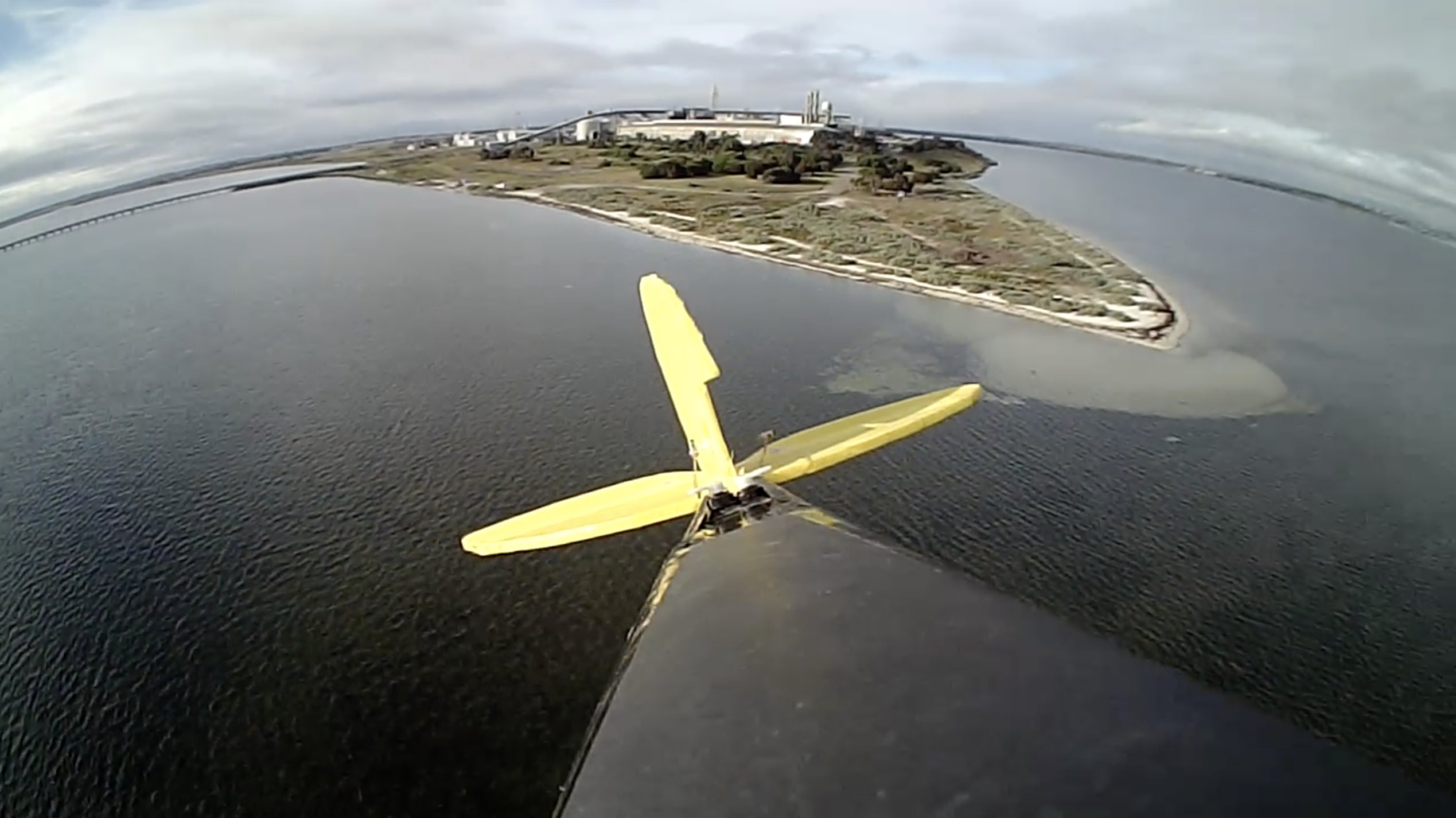
Here are some onboard stills from my scratch built Tigermoth

Build overview and configuration instructions


Onboard footage


Speedy Sloper tweaks

In really strong winds, like 25kn, it was obvious that the single boom V-tail design was still too flexy. So here's the next version.


I doubled the tail boom and changed to a conventional cross tail. At this stage I have no rudder, which works fine for speed runs. If I wanted more aerobatic performance from this glider a rudder would be essential.

I've added balsa fillets at the tail join for a bit more strength.


It's all much stiffer and is working well. So far I have only flown in a 15kn breeze, can't wait for a decent blow.


Friday, 15 January 2016

Speedy V-Tail sloper

For the last 2 weeks the wind strength has rarely dropped below 20kn. To keep flying I needed to
design something that could handle strong winds. The obvious candidate was a speedy slope racer.

The balsa-pod version of my Ultralight Sloper was available because it was superseded by the mad-flipping Fusion. Here are the mods needed to transform it into a high wind speedster.

V-Tail 1

Many slope racers use a V-Tail, and I had never tried one, so that was my first mod. I used tape covered 3mm balsa, hot glue and guessed the dimensions. The tail servos are down on the tail, which is not ideal. Not so much for the extra tail weight but the added aero drag.

It flew OK but did not track well at all, drifting and wandering side to side. This prototype V-Tail did not provide enough vertical area.


V-Tail 2

Further reading here suggested that my V angle should be sharper, about 110º and the area needed to be increased.

That improved the tracking heaps but I noticed my tail boom was twisting alarmingly when operating the rudder, as demonstrated in the video below.

Rudder function on a V-Tail is not as effective as a conventional vertical rudder because the control surfaces are acting at an angle to the airflow.  Most of the force goes into twisting the tail rather than moving it sideways, and the twist is in the wrong direction, a bit like adverse yaw from the ailerons.
Seems like V-Tails prefer more bank and yank style flying.


V-Tail 3

To increase the stiffness I shortened the tail boom by 150mm, cut 20cm off the 1.5m wing and 30mm off each tail section.

The shorter tail boom and smaller tail reduced the flex nicely resulting in much better speed and tracking.

In strong wind you can add ballast to give more momentum and penetration, which results in more speed. With a 2200mAH Lipo plus an extra 50g in metal washers it could handle 30kn flying crazy fast.

These photos show the final dimensions.

Flying weight with 1300mAH Lipo - 500g
Add ballast to taste
Wing - RG15 160mm chord
XPS foam hot wire cut
Covered with document laminating film
Servos - TGY9018 x 4


Strong wind V-Tail sloper overview and flights


Future design for more speed

For more speed I'll need to increase the tail stiffness further and reduce the drag.
My next high wind sloper design will have two tubes glued together for a stiffer tail boom and a conventional tail for less twisting. With a stiffer tail boom I should be able to place the servos in the fuselage for less drag, and run long push rods to the tail.

Weight is not a problem with these slopers, in fact more weight means more speed.

Stay tuned for updates.


Saturday, 19 December 2015

Simple 3 channel trainer

This design was inspired by a friend who wanted to take one of my "retired" planes to learn how to fly. So I gathered bits and pieces together and tried to come up with an easy to fly, crash proof trainer.

It only has rudder elevator and throttle, no ailerons. I wanted it to be as light as possible for slow and easy flight with a big energy absorbing nose and a tough fuselage.


The fuselage was shaped from a 50 x 100 x 370 block of XPS insulation foam and the tail planes are 8mm panels of the same foam. The boom is a Skyshark P4X 7.6mm tube.

The hotwire-cut 170mm clark y wing comes from rescued sections of the drowned Fokker (which now has new wings) Three x 360mm sections were glued together with the tips each raised 120mm. No spars are needed to hold the polyhedral due to the tape covering and large join surface area for gluing.


The nose is soft packing foam covered with tape and completely encases the 1300mAh Lipo battery.

The motor is the original Bixler 2, servos are cheap 9g HXTs, and it has a Plush 18A ESC and HobbyKing 3 channel receiver.

All up weight with the battery adds up to 550g, giving a slow continuous cruising flight time of over 30min.

This plane is very smooth and stable and with correct trim will fly hands off.

At this stage the nose, fuse and wings are almost bullet proof, but the tail planes are a bit too delicate. Thinner sheets of XPS foam are quite brittle so some kind of reinforcing is needed.  Both the elevator and rudder have cracked during the test flights so I have added a 0.5 x 3mm CF spars.

Might be better to use depron or corflute for the tail.


Dimensions


Flight video - motor slope soaring

Build video


UPDATE 30 March 2016 

After some tough flight testing by my dedicated student test pilot it became apparent that this tail
design was not crash proof enough.

So here is the new tougher tail design made from depron. The tail to boom join has extra foam fillets either side for more gluing area and to raise the elevator a little.

The new wing has more area and less polyhedral for smoother flight.


Update overview video

Tail build video

Dimensions for the updated tail design


MATERIALS
New Stuff iron-on film - EZload laminate - http://www.neopostonline.com.au/lamination/ez-load-roll-film

BUILD VIDEOS


Saturday, 31 October 2015

1.1m Fokker Dr 1 triplane

Two wings on the Tigermoth worked so well I had to take the next step...three wings.


The most famous triplane is the Red Baron's Fokker Dr1.

My wings are stiff enough not to need inter plane struts so I decided to stick to the familiar rubber band mounts. That meant I had to come up with a method for creating a rigid mount for the top wing. I recorded detailed build videos along the way.

SPECS
Top Wing - Top 1.1m, iron-on laminate and packing tape. 0.5 x 3mm CF spars
Middle and lower wings - 950mm and 900mm. packing tape. 0.5 x 3mm CF spars
Airfoil - 170mm Clark y
Fuselage - 6mm depron, 3mm ply nose, packing tape.


Saturday, 3 October 2015

1.2m Tigermoth

I have never been much interested in scale model planes apart from the Tigermoth biplane. Tigermoth World is nearby and for my 40th Virginia and I went for aerobatic joy flights...great fun.

I already had enough practice hot wire cut wings laying around for the build so I decided to have a go. I gathered scale measurements from tiger moth photos and made the adjustments needed for a 1.2m wingspan model.

The fuselage is 6mm depron covered with yellow packing tape to mimic the plane I flew in. I added 3mm ply under the nose to take landing impacts and a 5mm ply motor mounting firewall.

The motor is a Hextronic DT750 which had plenty of thrust, especially with a 4S battery. Prop is 11 x 5.5", ESC 40A Plush. 3000 mAH 3S or 4S Lipo gives 20+ minutes of cruising.

Here are build and flight videos of this great looking vintage biplane. It flies just like the real thing, slow and steady with just enough aerobatic capability.