Now called the N3UTRON thanks to YouTuber Richard from 28th St. Air Land & Sea. "why not go all the way? it’s the N3UTRON. its a subtle reference to Ed’s photon, the u glider 3 channel, and andrew’s last name"
Here are the dimension of a 3 channel motor glider made using 3mm and 6mm depron and a woven CF
arrow shaft.
Armin wing construction with 6 x 1mm CF strip spar.
HobbyKing contact glue and hot glue.
Document laminating film wing and tail covering. Scotch Tough tape fuselage covering.
Flying weight is 300g with a 950mAH 2S LiPo
Motor and 5 x 3" prop from the U-Glider
Spring / Pull control
2 x 13g metal geared servos
12A ESC
Wingspan 140cm.
Chord width 14cm.
Chord thickness 14mm
3mm depron version of the wonderful little twin boom Eachine Micro Skyhunter.
Dimensions are similar to the original but with a slimmer fuselage.
1300mAH 3S battery and FPV gear.
CG best around 35mm.
The final version has a shorter nose, reinforced horizontal stab and rounded wing tips
For the last 2 weeks the wind strength has rarely dropped below 20kn. To keep flying I needed to
design something that could handle strong winds. The obvious candidate was a speedy slope racer.
The balsa-pod version of my Ultralight Sloper was available because it was superseded by the mad-flipping Fusion. Here are the mods needed to transform it into a high wind speedster.
V-Tail 1
Many slope racers use a V-Tail, and I had never tried one, so that was my first mod. I used tape covered 3mm balsa, hot glue and guessed the dimensions. The tail servos are down on the tail, which is not ideal. Not so much for the extra tail weight but the added aero drag.
It flew OK but did not track well at all, drifting and wandering side to side. This prototype V-Tail did not provide enough vertical area.
V-Tail 2
Further reading here suggested that my V angle should be sharper, about 110º and the area needed to be increased.
That improved the tracking heaps but I noticed my tail boom was twisting alarmingly when operating the rudder, as demonstrated in the video below.
Rudder function on a V-Tail is not as effective as a conventional vertical rudder because the control surfaces are acting at an angle to the airflow. Most of the force goes into twisting the tail rather than moving it sideways, and the twist is in the wrong direction, a bit like adverse yaw from the ailerons.
Seems like V-Tails prefer more bank and yank style flying.
V-Tail 3
To increase the stiffness I shortened the tail boom by 150mm, cut 20cm off the 1.5m wing and 30mm off each tail section.
The shorter tail boom and smaller tail reduced the flex nicely resulting in much better speed and tracking.
In strong wind you can add ballast to give more momentum and penetration, which results in more speed. With a 2200mAH Lipo plus an extra 50g in metal washers it could handle 30kn flying crazy fast.
These photos show the final dimensions.
Flying weight with 1300mAH Lipo - 500g
Add ballast to taste
Wing - RG15 160mm chord
XPS foam hot wire cut
Covered with document laminating film
Servos - TGY9018 x 4
Strong wind V-Tail sloper overview and flights
Future design for more speed
For more speed I'll need to increase the tail stiffness further and reduce the drag.
My next high wind sloper design will have two tubes glued together for a stiffer tail boom and a conventional tail for less twisting. With a stiffer tail boom I should be able to place the servos in the fuselage for less drag, and run long push rods to the tail.
Weight is not a problem with these slopers, in fact more weight means more speed.
This design was inspired by a friend who wanted to take one of my "retired" planes to learn how to fly. So I gathered bits and pieces together and tried to come up with an easy to fly, crash proof trainer.
It only has rudder elevator and throttle, no ailerons. I wanted it to be as light as possible for slow and easy flight with a big energy absorbing nose and a tough fuselage.
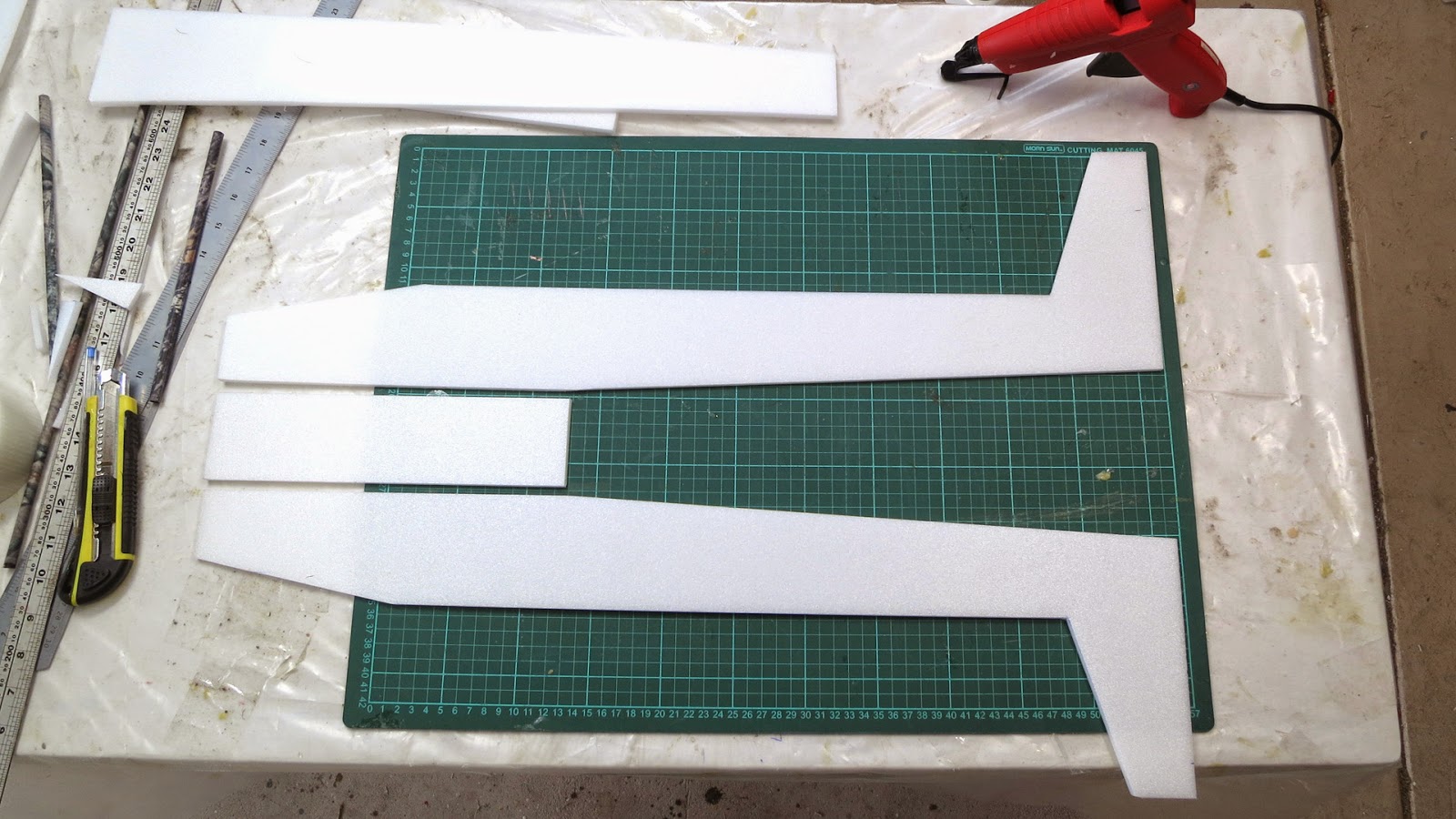
The fuselage was shaped from a 50 x 100 x 370 block of XPS insulation foam and the tail planes are 8mm panels of the same foam. The boom is a Skyshark P4X 7.6mm tube.
The hotwire-cut 170mm clark y wing comes from rescued sections of the drowned Fokker (which now has new wings) Three x 360mm sections were glued together with the tips each raised 120mm. No spars are needed to hold the polyhedral due to the tape covering and large join surface area for gluing.
The nose is soft packing foam covered with tape and completely encases the 1300mAh Lipo battery.
The motor is the original Bixler 2, servos are cheap 9g HXTs, and it has a Plush 18A ESC and HobbyKing 3 channel receiver.
All up weight with the battery adds up to 550g, giving a slow continuous cruising flight time of over 30min.
This plane is very smooth and stable and with correct trim will fly hands off.
At this stage the nose, fuse and wings are almost bullet proof, but the tail planes are a bit too delicate. Thinner sheets of XPS foam are quite brittle so some kind of reinforcing is needed. Both the elevator and rudder have cracked during the test flights so I have added a 0.5 x 3mm CF spars.
Might be better to use depron or corflute for the tail.
Dimensions
Flight video - motor slope soaring
Build video
UPDATE 30 March 2016
After some tough flight testing by my dedicated student test pilot it became apparent that this tail
design was not crash proof enough.
So here is the new tougher tail design made from depron. The tail to boom join has extra foam fillets either side for more gluing area and to raise the elevator a little.
The new wing has more area and less polyhedral for smoother flight.
I was keen to try some aerobatics with powered planes but The Red was not quite up to the task. Too much of a glider and not enough rudder. So this is what I came up with.
It has a 1.2m x 180mm 12% chord Armin wing and a 700mm fuselage both made from 6mm depron covered with 75 micron document laminating film. That is the thicker laminate and it added lots of strength.
I also wanted to try a design with the tail as part of the fuselage, and test a full flying elevator setup. Both are working very well so far.
Fuselage construction started with the side and bottom panels in uncovered depron
The sides were glued on top of the bottom panel, which defines the width of the front area.
The tail halves were glued together giving the taper curve, then top and bottom panels added.
The fuselage was then covered with 75 micron laminate.
This added a great amount of strength, especially to the narrow tail area.
The 2826/10 1400kV motor is mounted to 5mm plywood with ventilation holes drilled out. Initially I built in some down thrust but I am still testing to find the right amount. Plastic washers can be added or removed to vary the angle.
The most radical feature of this design is the flying elevator. The whole horizontal stabiliser pivots on a 3mm carbon fibre rod which also acts as the spar. The rod passes through a brass tube glued into the tail. The inner diameter of the brass tube must be just bigger than the CF rod to give free movement but minimal wiggle. To hold the brass tube firmly there are 25mm discs of foam sandwiched between ID card plastic on either side.
Plans
Overview and build video
Field and slope flights
SPECS
Armin wing span - 1.2m (47")
Airfoil chord - 190mm (7") including 45mm (1.5") ailerons
Airfoil thickness - 23mm (12%) using 9mm formers
Spar - Skyshark P4X 7.5mm x 850mm, 57mm back from LE
Fuselage Length - 700mm (27.5")
Flying weight (2200mAh LiPo) - 770g
Full span Ailerons / Flaperons
Full flying Elevator
Large Rudder
TGY 9018MG servos x 4
Motor - Turnigy 2826/10 1400kV with 8x4 prop
ESC - Plush 40A
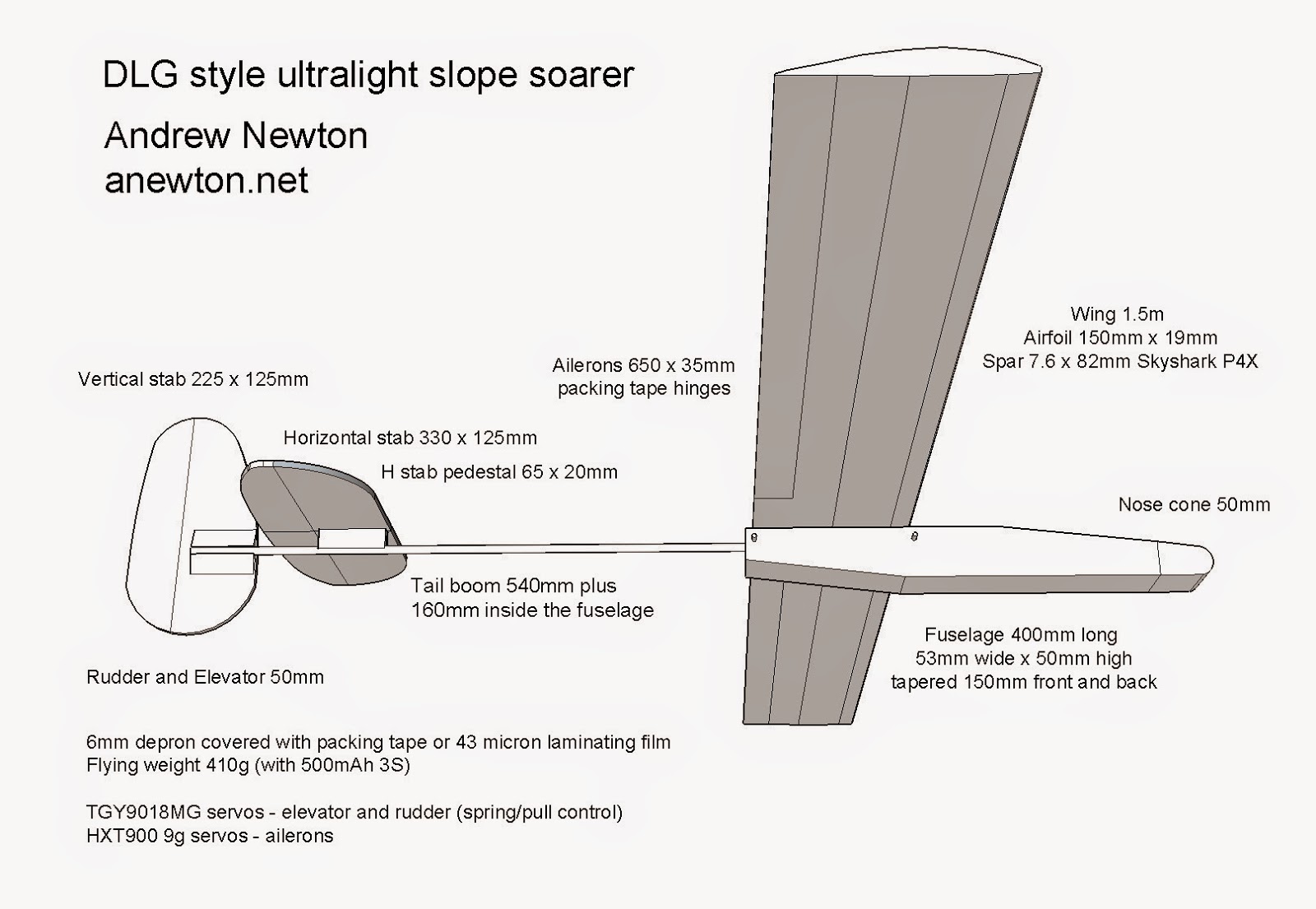
The design for this lightweight aerobatic slope soarer was inspired by DLGs or discus launch gliders.
It will work in anything over 5kn on a decent slope and in 10kn it will work on any slope.
The rudder and elevator are operated by a pull line acting against a torsion spring.
This unique system means the servos can be forward in the fuselage and there are no pushrods going to the tail.
The trick is to make a torsion spring strong enough to operate the control surface against the airflow
but not so strong as to overpower the servo.
The 0.4mm SS wire provided as pushrods for the Versus DLG turns out to be perfect.
UPDATE March 2015: On really hot days the rudder and elevator servos have moved out of position as the glue softened. I have added more foam packing and glue to fix them securely. The trailing edge of the wing has also popped open twice. I removed the ailerons, re-glued then taped the join, then reattached the ailerons. In the original build, by cutting out the ailerons from the wing, I removed too much of the glue holding that join.
This twin boom pusher is similar to the 1.3m Depron Spectre, however it has a straight 1.65m (65") x 190mm depron Armin wing and twin rudders.
1.3m Depron Spectre and 1.65m Twin Boom pusher
Initially it was designed it as a 1.8m light-wind slope soarer but didn't perform as well as I wanted. The longer tail booms and larger wing span made it too flexy and delicate. I was also comparing the performance to a motorless Phoenix 2000, which is a sensational sloper.
Shortened tail booms and wingspan stiffened up the airframe nicely and the addition of a motor fuselage turned it into an excellent FPV cruiser and medium wind FPV sloper. It tracks well in a straight line and has a decent glide angle but is quite agile like the Spectre.
Instead of using packing tape to cover the depron I used document laminating film, often referred to as New Stuff in the RC world. It is ironed on with a warm iron before bending the airfoil and fuselage, and works very well. It's tougher and easier to apply than packing tape.
Additional strengthening ...
6x1mm CF strip glued along the front of the elevator.
Heat bent UPVC brackets for the rudder to elevator joins.
I used twin rudder servos rather than one servo and a long vulnerable connecting pushrod between the rudders. Full length wing spar made from 2 Skyshark P4X spars joined with an internal CF rod joiner and epoxy.