It's a 16 channel transmitter that uses OpenTX open-source firmware. It has telemetry, sound, haptic (vibration) feedback and lua scripting capability. Telemetry logs are recorded on a micro SD card when activated.
For about A$250 this is a stunning transmitter. It must be one of the most programmable and adaptable transmitters currently available.
All the parts are easily replaceable and readily available from places like Banggood, Hobby King International and BoltRC in Australia.
There are no in-depth manuals for the Taranis or openTX but there are lots of online resources like OpenTX University, YouTube, and RCGroups.
I thought it would be a good idea to record the tweaks, mods and programming revelations as I progress. Mostly so that I don't forget them but also to share with like minded RC pilots.
Replacing the LCD
I cracked the LCD screen by dropping the Taranis onto a hard floor. It was in a backpack at the time but not a padded one. The Taranis still worked fine but not the screen. This video shows how to replace the screen. Very easy, no soldering, plug and play. New LCD bought from BoltRC in Perth for A$33 plus postage. Note that this video is for the Taranis plus. The original Taranis uses a different LCD. Some websites say that fine soldering is required but that refers to the backlight not the LCD.
Switching the switches
For DLG launching I like a momentary switch on the top left of the transmitter. Launch mode requires a brief blip of "up elevator" to rotate the DLG skywards, but my right hand is launching the glider, hence the need for a momentary switch on the left.
As supplied the Taranis has a momentary switch on the top right and a 2 position switch on the top left. Swapping them could not be easier. Both switches have their leads plugged. So you just need to open the back of the transmitter, unplug the leads from the switches, undo the retaining nuts and swap the SF and SH switches. Plug back in, replace the back and it's done.
The 2m Hobby King Phoenix 2000 was designed to be a motor thermal glider, but it works very well as a motor-less slope soarer.
Soren from Denmark, speedsterDEN on YouTube, has some amazing videos of sloping and dynamic soaring with this very cheap glider.
Slope soaring is fairly rough on foam gliders due to the rough and often uncontrolled landings.
The Phoenix has a tough plastic fuselage which is perfect for the job. However the wing and tail need some strengthening mods to help keep it in one piece.
My flap control horns pulled through the foam after a few flights so I added ID card plastic reinforcing to spread the load.
The wing is supplied with bolts and plastic caps to secure to the fuselage. These tore through the thin foam around the rear mounting bolt after a few rough slope landings. I decided to change to a rubber band tie-down mounting method for more durability. The wings were glued and taped together permanently.
I drilled 5mm holes in the fuselage to fit the CF tie-down rods. No reinforcing in this area is needed. The rods are held in place with hot glue.
Here is the wing securely held in place with rubber bands.
Below are videos explaining these mods and showing some flights.
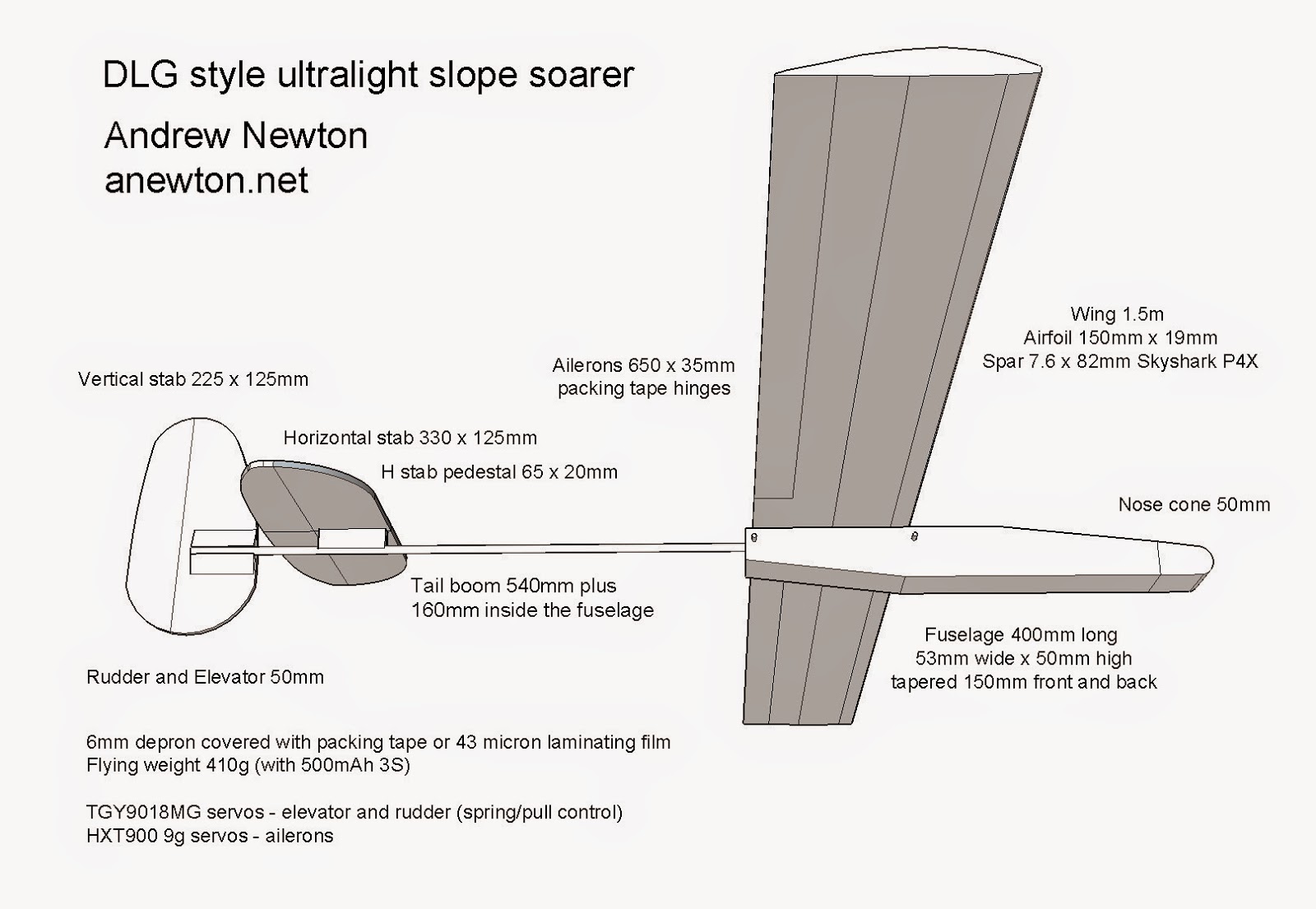
The design for this lightweight aerobatic slope soarer was inspired by DLGs or discus launch gliders.
It will work in anything over 5kn on a decent slope and in 10kn it will work on any slope.
The rudder and elevator are operated by a pull line acting against a torsion spring.
This unique system means the servos can be forward in the fuselage and there are no pushrods going to the tail.
The trick is to make a torsion spring strong enough to operate the control surface against the airflow
but not so strong as to overpower the servo.
The 0.4mm SS wire provided as pushrods for the Versus DLG turns out to be perfect.
UPDATE March 2015: On really hot days the rudder and elevator servos have moved out of position as the glue softened. I have added more foam packing and glue to fix them securely. The trailing edge of the wing has also popped open twice. I removed the ailerons, re-glued then taped the join, then reattached the ailerons. In the original build, by cutting out the ailerons from the wing, I removed too much of the glue holding that join.
This twin boom pusher is similar to the 1.3m Depron Spectre, however it has a straight 1.65m (65") x 190mm depron Armin wing and twin rudders.
1.3m Depron Spectre and 1.65m Twin Boom pusher
Initially it was designed it as a 1.8m light-wind slope soarer but didn't perform as well as I wanted. The longer tail booms and larger wing span made it too flexy and delicate. I was also comparing the performance to a motorless Phoenix 2000, which is a sensational sloper.
Shortened tail booms and wingspan stiffened up the airframe nicely and the addition of a motor fuselage turned it into an excellent FPV cruiser and medium wind FPV sloper. It tracks well in a straight line and has a decent glide angle but is quite agile like the Spectre.
Instead of using packing tape to cover the depron I used document laminating film, often referred to as New Stuff in the RC world. It is ironed on with a warm iron before bending the airfoil and fuselage, and works very well. It's tougher and easier to apply than packing tape.
Additional strengthening ...
6x1mm CF strip glued along the front of the elevator.
Heat bent UPVC brackets for the rudder to elevator joins.
I used twin rudder servos rather than one servo and a long vulnerable connecting pushrod between the rudders. Full length wing spar made from 2 Skyshark P4X spars joined with an internal CF rod joiner and epoxy.
Everyone has heard about the 2m Radian. It's a very simple no-aileron motor glider with graceful curved up wings and has fantastic thermalling abilities.
For A$200 the "Plug and Play" version comes with a good quality motor and servos fitted and not a lot of assembly required. Add your own receiver, battery and transmitter.
I bought mine from RCWorld in Geelong. They have all the spares too.
Like all planes there are a few issues to be sorted out before flying. It is very light and flexy, especially in the tail area, and some of the fittings are inadequate. Most owners carry out strengthening mods and Paul Naton, well known glider tutorial DVD producer, has published a mod video which is essential viewing. Paul Naton's Radian mod video Essential mods needed before the first flight
Pathetic plastic clevis connectors
The pin on mine broke just trying to clip on to the control horn the very first time! What were Parkzone thinking? These ridiculously weak plastic clevis connectors are just wrong. May be OK for a tiny indoor foamie but not a 2m thermal glider.
I couldn't find another connector to fit the pushrod thread so decided to beef up the existing one with a piano wire pin. Just needed to carefully drill holes in the cheeks using a piece of the wire as a drill bit. Tight fitting shrink wrap (not shrunk) keeps the pin in place and connector cheeks pulled in.
Staples into foam?
What is the purpose of these staples? They were straddling the pushrods where some sort of fixing structure should have been. I pulled them out, they were already floating loose, and threw them away because they offended me!
My solution was to use tough clear gaffer tape to fix the pushrods securely to the fuselage leading into the rudder and elevator.
Missing canopy magnet
The canopy is held in place by magnets front and rear. Unfortunately one of the fuselage magnets was missing. Luckily I had a replacement in my spares box and I glued it in with gorilla glue.
Changed ESC connector
The Parkzone ESC comes with an unfamiliar (to me) blue connector, to match Parkzone batteries I guess. All my LiPos have XT60 connectors so a little soldering was required to swap the ESC to XT60.
Receiver bay surgery
The receiver bay is made for a small Spektrum Rx but all I had was a bulky 8ch Turnigy Rx. All I had to do was cut out a little mound of foam to make it fit.
After those easy repairs/mods it was airworthy and ready for the maiden flight. The day was windier than ideal but the Radian performed superbly. No thermalling on the first day but on subsequent days I climbed to frightening heights, lots to learn.
I had previously checked the range of my Turnigy 9X transmitter with a 6ch Hobby King receiver. I got more than 800m at low altitude flying along coastal dunes. The highest I have had the Radian is 300m, and I wouldn't want to go too much higher at this stage, so it would have no problems with signal strength. At 800m the glider would not be visible anyway.
Optional performance mods - (inspired by Paul Naton)
Elevator control horn placement
The control horn was relocated inwards about 12mm to give the pushrod a straighter run. The control horn base was shaved off where it now overhangs the elevator. Elevator was stiffened along it's span using 12k carbon tow and epoxy.
Elevator hinge was taped both sides with clear packing tape for durability. Moulded foam hinges will fail eventually, they are not designed to last. Fixed the horizontal stab in its slot with clear gaffer tape both sides, above and below.
Fuselage stiffening
Added 3 strands of 12k carbon tow along the bottom of the fuselage boom to reduce tail flex. I covered that with clear packing tape for smoothness.
Wing slot top strengthening
I added 3 strands of 12k carbon tow over the top of the wing slot because this area is quite thin and prone to failure.
Wing leading edge tape
After a few flights I noticed that the leading edge was becoming dented and scratched so I added clear packing tape back to 50mm from the LE top and bottom
Wing retaining velcro / magnets
There are many horror stories on the forums about wings falling out in flight. They are very weakly held in with friction and slightly keyed foam blocks that do nothing at all.
Initially I used sticky back velcro on all the meeting surfaces of the two wing halves but that pushed the wings apart by almost 1cm. My current solution is magnets glued to 40mm dowel inserts. These are quite securely glued into the wing roots with epoxy also strengthening that area nicely.
Rudder root strengthening
To stiffen the area at the base of the rudder I cut a slot and glued in a 6x1mm carbon strip pushing it right down into the foam of the fuselage.
Decalage mod
All of these stiffening mods add a little tail weight moving the CG rearward. This is actually a good thing according to the experts. The stock CG of 70mm is too far forward requiring up elevator to fly level. The Radian is designed with lots of horizontal stabiliser decalage angle as seen below and performance can be improved by moving the CG back and reducing the decalage angle. Well that's the much-debated theory anyway.
I tried the decalage mod by slicing out the foam wedge (marked below) and repositioning the horizontal stab. At this early stage of my thermal gliding journey it felt like too much and I couldn't get it to fly smoothly. So I have gone halfway back. Seems like a good compromise now with my CG at 78mm or 3".
Painted bottom surface of the wing
For visibility and orientation. This glider starts to be difficult to see higher than 300m. Solid black seems to be the most visible colour at that distance.
Radian videos
Trying different camera mounting spots
Thermal flight in Google Earth, recorded with a GPS watch
Slope Soaring
and finally Stormy loves the box so all is good.
UPDATE: I left customer feedback on the Horizon Hobby site about the broken clevis connector and missing magnet and they sent me replacement pushrods and canopy, posted in two separate parcels from US to Australia. Now that is awesome customer service.
Here's a demo video covering how I add dihedral to a depron Armin wing.
I show how to bend a 200mm length of ali tube to set the dihedral angle and hold the spars.
This video also shows my swappable motor mount for the Red Sloper and other construction tips.
Here's a slope soaring video showing how the dihedral makes the Red Sloper into a smooth and relaxing glider while slightly reducing the aerobatic capability.
Here's a quick, cheap and easy vibration-damping camera mount using 2 cable ties and an ID card. It only takes a few minutes to make and greatly reduces those annoying jelly waves often seen in onboard video.
Tools needed are an office hole punch, scissors, side cutters and a marker pen. Materials needed are two small rubber bands, an ID card and two 4mm x 200mm cable ties.
Cut the card in half and punch 4 holes in each roughly 1cm in from the edges.
Double wrap the rubber bands on one card towards the middle from the holes.
Thread through the cable ties to form the springs. Start underneath and thread up out and around the card edges, then back through the bottom card into the middle. Continue on threading in and out the holes till you come back to the start.
Adjust the size of the loops until the top deck is level or possibly tilted forward a little.
Clip off the excess and it's done.
You still need to balance your props but this mount takes care of the vibrations that you can't fix.
Velcro on the bottom is a good way to attach the mount to a plane or even electrical tape for temporary positioning.
Here is the full build in real time - about 4 minutes.
This video shows the comparison of with and without the anti-vibe mount.

 As supplied the Taranis has a momentary switch on the top right and a 2 position switch on the top left. Swapping them could not be easier. Both switches have their leads plugged. So you just need to open the back of the transmitter, unplug the leads from the switches, undo the retaining nuts and swap the SF and SH switches. Plug back in, replace the back and it's done.